$isLighthouse = (int) isLighthouse();
DOWNLOAD

We'd Love to Hear from You

CAPTCHA

We'd Love to Hear from You

CAPTCHA

Metal PCB Capability

SENTAK Metal Core PCB (MCPCB) Manufacturing Capabilities

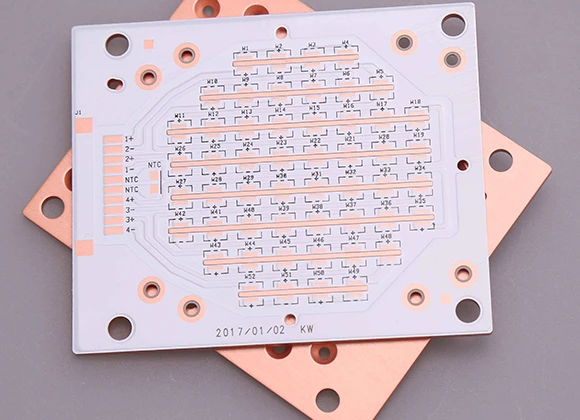
Document Purpose: This specification details the manufacturing competencies of SENTAK for Metal Core Printed Circuit Boards, a specialized solution for applications requiring superior thermal management. MCPCBs utilize a metal substrate (typically aluminum or copper) as a base for heat dissipation, with a thermally conductive dielectric layer providing electrical isolation. This document defines our standard and advanced process capabilities.

Metal PCB Capability
1.0 Material Construction & Types

Parameter / Type

Standard Capability

Advanced / Specialized Capability

Key Characteristics & Applications

Metal Substrate

Aluminum 5052, 6061

Copper C1100, Stainless Steel, Composites

Aluminum: Cost-effective, good thermal performance. Copper: Superior thermal conductivity, higher cost.

Metal Base Thickness

0.8 mm - 3.0 mm

0.5 mm (Ultra-Thin) to 6.0 mm (Heavy Heatsink)

Common: 1.0 mm, 1.5 mm, 2.0 mm. Tolerance: ±0.1 mm.

Dielectric Layer Type

Standard Thermal Conductive Polymer

High-Performance Ceramic-Filled Polymer

Electrically insulating, thermally conductive.

Dielectric Layer Thickness

75 µm - 100 µm (3-4 mil)

50 µm (2 mil) to 150 µm (6 mil)

Thinner = lower thermal resistance. Constrained by voltage isolation needs.

Copper Circuit Layer

1 oz (35µm) - 2 oz (70µm) ED Copper

0.5 oz (18µm) to 10 oz (350µm) Heavy Copper

ED Copper standard. Heavy copper for high current paths.

2.0 Thermal Management Performance

Parameter

Standard Capability Range

Notes & Test Method

Thermal Conductivity of Dielectric (k-value)

1.0 - 3.0 W/mK (Standard Polymer)

Advanced: 3.0 - 8.0+ W/mK (Ceramic-Filled). Key driver of thermal performance.

Thermal Resistance (Rθ)

Dependent on construction (k-value, thickness, area).

Calculated or measured per customer design. Lower is better. Typical range: 0.5 - 3.0 °C/W.

Breakdown Voltage (Dielectric Strength)

> 2.0 kVAC (Standard)

High Voltage: > 4.0 kVAC available. Tested per UL/IPC standards.

Comparative Tracking Index (CTI)

≥ 600V (Material PLC 0)

For creepage/clearance safety in high-humidity environments.

3.0 Mechanical & Dimensional Specifications

Parameter

Standard Capability

Advanced Capability

Notes

Max Panel/Board Size

300mm x 450mm

Up to 450mm x 600mm

Limited by metal substrate flatness and routing.

Board Outline Tolerance

±0.15 mm (±0.006")

±0.10 mm (±0.004")

CNC routing of metal base.

Flatness (Bow)

≤ 0.5% of diagonal length

≤ 0.3%

Critical for LED assembly and heatsink mating.

Metal Edge Burr

≤ 0.08 mm (3 mil) after deburring

≤ 0.05 mm (2 mil)

Smooth edges for safe handling.

Mounting Holes & Machining

Drilling, Counterbore, Countersink

Tapped threads, complex milled pockets/slots

For mechanical attachment to chassis or heatsinks.

Surface Finish on Metal Base

Bare, Anodized (Non-Conductive), Chromate Conversion Coating

Powder Coating, Silkscreen on metal

Anodizing improves corrosion resistance and electrical isolation.

4.0 Circuit & Imaging Specifications

Parameter

Standard Capability (1 oz Cu)

Advanced Capability

Notes for MCPCB

Min. Trace/Space

0.15 mm / 0.15 mm (6/6 mil)

0.10 mm / 0.10 mm (4/4 mil)

Affected by dielectric layer adhesion and etching process.

Min. Isolation (Copper to Metal Base)

0.5 mm (20 mil) recommended

0.3 mm (12 mil) (High CTI materials)

Critical for electrical safety and high-voltage clearance.

Etch Tolerance

±0.05 mm (±2 mil)

±0.03 mm (±1.2 mil)


Plated Through-Holes (PTH)

NOT AVAILABLE

N/A

Standard MCPCBs are single-sided. Vias require special (and costly) construction.

Thermal Vias

Non-Plated Holes in PCB, filled with thermal paste at assembly.

Metal-Cored Vias (complex process)

Used to attach component thermal pad directly to metal base.

5.0 Solder Mask & Legend

Parameter

Standard Capability

Notes

Type

High-Tg, Thermal Shock Resistant LPI Solder Mask

Must withstand LED reflow temperatures.

Color

White (Standard for LED), Black

Other colors (Blue, Green) available. White provides highest reflectivity for LEDs.

Solder Mask Registration

±0.10 mm (±4 mil)

Over metal core, registration can be more challenging.

Thermal Pad Definition

Solder Mask Defined (SMD) or Copper Defined (NSMD)

SMD recommended for better thermal pad alignment.

6.0 Surface Finishes (RoHS Compliant)

Finish Type

Recommendation for MCPCB

Rationale

HASL (Lead-Free)

Common & Robust

Good solderability, cost-effective. Thermal shock during process needs control.

OSP

Not Recommended

Poor performance with multiple heat cycles (LED rework).

Immersion Tin (ISn)

Good Alternative

Flat surface, good solderability.

Immersion Silver (IAg)

Good Alternative

Excellent solderability, flat surface for fine-pitch.

ENIG

Recommended for Fine-Pitch/Hi-Rel

Excellent flatness, oxidation resistance, ideal for wire bonding or QFN packages.

7.0 Quality Assurance & Reliability Testing

Test/Inspection Type

Standard Method

Purpose & Capability

Electrical Test (Continuity/Isolation)

Flying Probe

Verify circuit integrity and isolation from metal base.

Dielectric Withstanding Voltage Test

Hi-Pot Test, up to 4 kVAC

Validate insulation layer integrity and safety margin.

Thermal Conductivity / Resistance Measurement

ASTM D5470 or Laser Flash (on request)

Characterize or verify thermal performance of the dielectric layer.

Thermal Cycling Test

IPC TM-650 2.6.8, -40°C to +125°C

Assess solder joint and material adhesion reliability.

Peel Strength Test

IPC TM-650 2.4.9

Measure adhesion strength of copper to dielectric layer.

Visual & Dimensional Inspection

Per IPC-A-600 & IPC-A-610 (if assembled)


8.0 Application-Specific Design Guidelines (Quick Reference)

Application

Recommended Metal

Key Design Focus

High-Power LED Lighting

Aluminum 1.5mm - 2.0mm

Maximize copper area for heat spreading, white solder mask, sufficient isolation.

Power Converters (MOSFETs, IGBTs)

Aluminum or Copper

Use heavy copper (2oz+) for high-current traces, thermal vias under devices.

Automotive (LED Drivers, Headlights)

Aluminum, Anodized

High CTI dielectric (>600V), robust thermal cycling performance.

RF/Microwave (Power Amplifiers)

Copper, with high-k dielectric

Requires tight impedance control and maximal heat extraction.

Engineering Advisory

MCPCB design requires careful consideration of thermal, electrical, and mechanical interfaces. Early DFM consultation is strongly recommended to optimize material selection, layout for manufacturability, and thermal performance.

Your Design Deserves Our Discipline.

Partner with a manufacturer where quality is a measurable, managed outcome.

Contact Us

Related Products