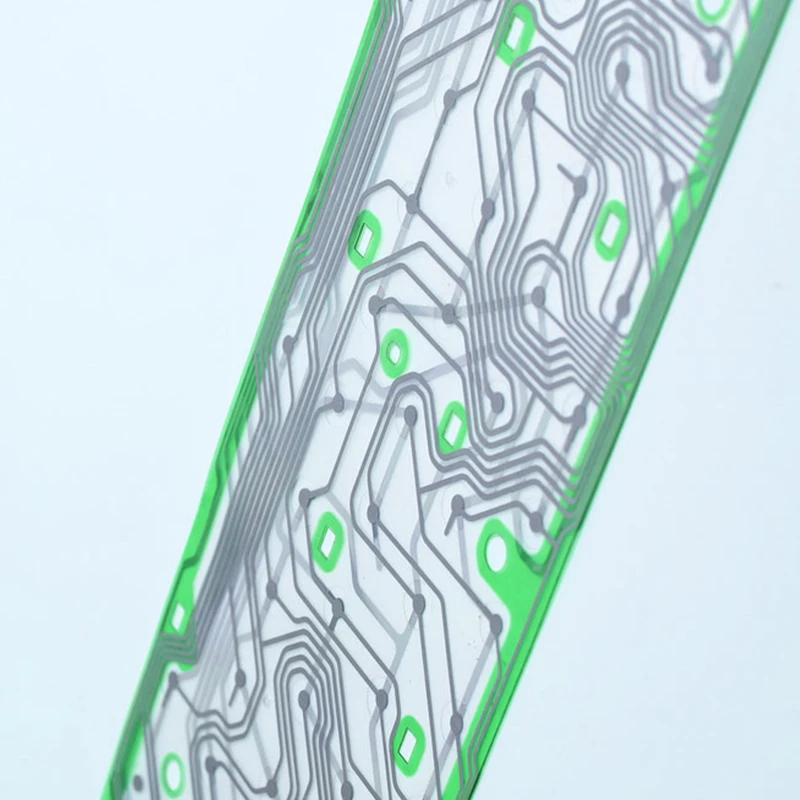
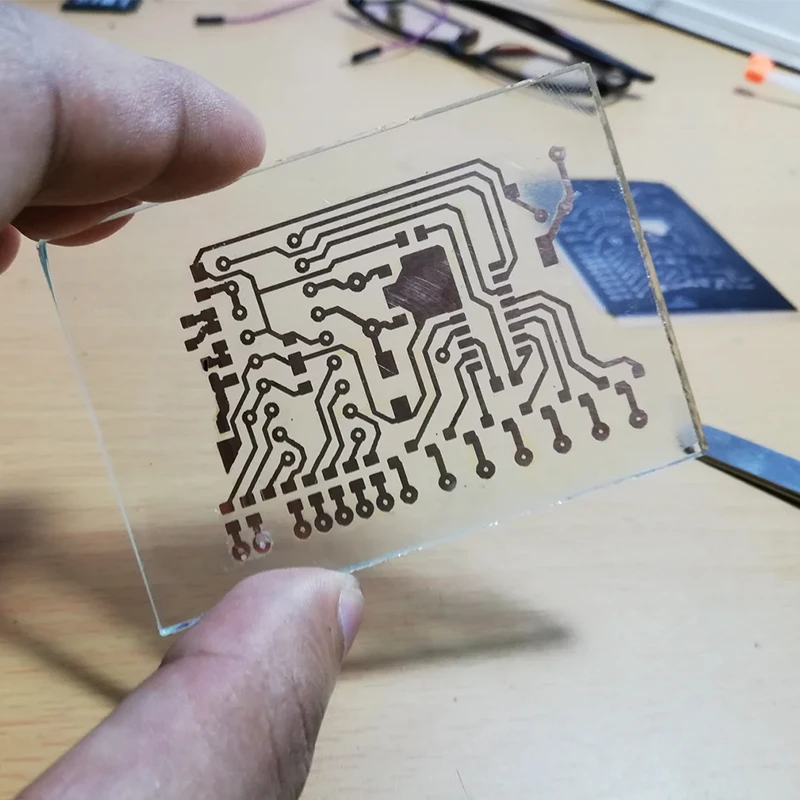
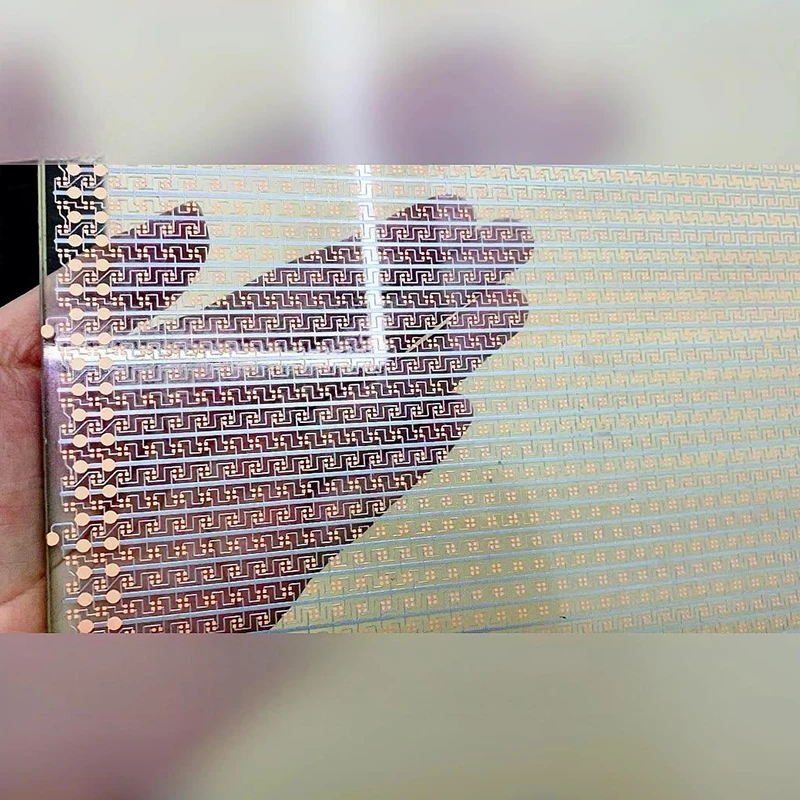
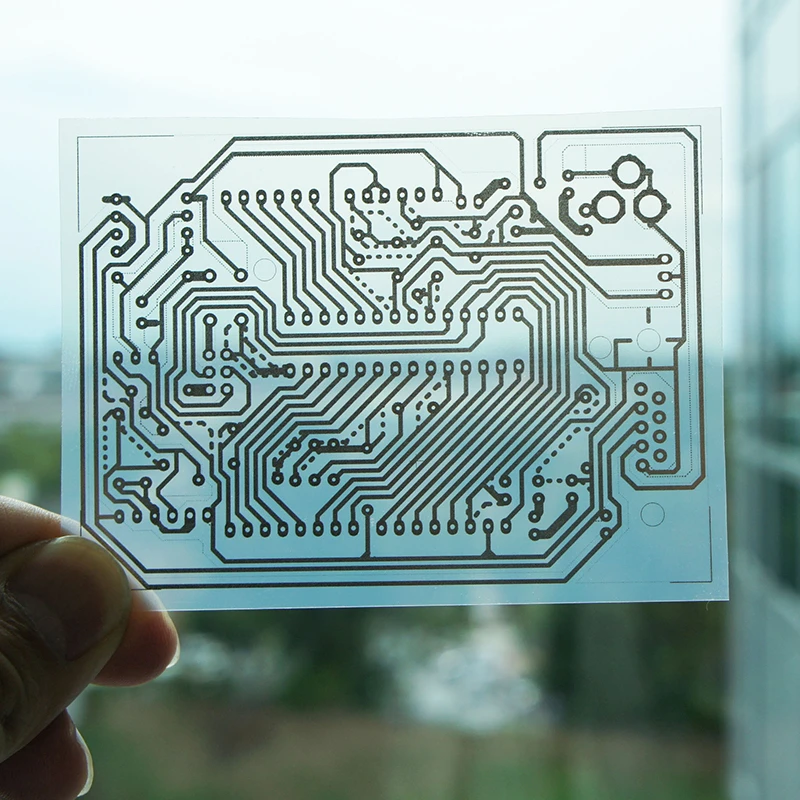
We possess the specialized equipment and cleanroom environment required for high-precision glass substrate processing.
Technical Specifications of Glass PCB:
● Substrate Materials: Borosilicate Glass, Fused Silica/Quartz.
● Standard Thickness: 100µm to 1.1 mm.
● Metallization: Thin-Film(Ti/Cu, Cr/Cu seed layers)with Electrolytic/Electroless Plating.
● Minimum Trace/Space: 8µm/8µm(standard), down to 5µm(advanced).
● Through-Glass Via(TGV)Diameter: 30µm-100µm.
● Surface Finishes: ENIG, Electrolytic Gold, Immersion Silver.
Quality&Assurance:
● Standards: Fabricated and inspected to relevant MIL-PRF and IPC standards for hybrid circuits.
● Testing: 100%Electrical Testing.High-Frequency Network Analysis for RF performance.Microscopic inspection for trace integrity.
● Inspection: White Light Interferometry for surface planarity measurement.Cross-sectioning for TGV and metallization quality.
Design Considerations for Glass PCBs
Glass is dimensionally stable but more brittle than conventional organic PCB laminates. The mechanical design must therefore be considered from the beginning.
Recommended practices include:
- Use rounded substrate corners
- Avoid sharp internal cutouts
- Maintain sufficient copper-to-edge clearance
- Control TGV diameter, pitch and aspect ratio
- Avoid excessive via density in one area
- Provide uniform mechanical support
- Avoid concentrated mounting pressure
- Define thermal paths for heat-generating devices
- Specify impedance requirements before circuit patterning
- Coordinate optical windows with the metallization layout
Early collaboration with the Glass PCB Manufacturer helps align the design rules with the selected material and fabrication process.
Glass PCB vs FR-4 PCB
Glass PCB and FR-4 PCB use different substrate materials, resulting in differences in thermal performance, dimensional stability and application fields. Glass PCBs are mainly used for high-precision and advanced electronic applications, while FR-4 PCBs are widely used in general electronic products.
| Feature |
Glass PCB |
FR-4 PCB |
| Substrate Material |
Glass substrate |
Fiberglass reinforced epoxy resin |
| Thermal Stability |
Excellent thermal stability with low thermal expansion |
Good thermal performance for general applications |
| Dimensional Stability |
Higher dimensional accuracy and less deformation |
Suitable for standard electronic applications |
| Electrical Performance |
Suitable for high-precision and high-frequency applications |
Widely used for conventional electronic circuits |
| Transparency |
Available with transparent or optical glass substrates |
Not transparent |
| Application |
Optoelectronics, sensors, displays, semiconductor equipment |
Consumer electronics, industrial control, power electronics |
| Cost |
Higher due to advanced material and processing requirements |
More cost-effective for mass production |
Glass PCBs are ideal for applications requiring high precision, excellent stability and special optical properties, while FR-4 PCBs remain the preferred choice for general-purpose electronic devices due to their mature technology and cost advantages.
Custom Glass PCB Manufacturer
SENTAK provides custom Glass PCB manufacturing for applications requiring high dimensional stability, precise circuit geometry, low moisture absorption and stable electrical characteristics.
Unlike conventional FR-4 PCB production, glass substrate processing requires specialized via formation, metallization, thin-film patterning and handling controls. Our engineering team reviews the substrate material, thickness, circuit layout, through-glass vias and final assembly requirements before production.
Our custom Glass PCB services include:
- Borosilicate glass substrates
- Fused silica and quartz substrates
- Through-glass via substrates
- Fine-line copper circuit patterns
- Thin-film metallization
- Controlled impedance structures
- Optical window integration
- Glass interposers
- Prototype and low-volume production
- Surface finishing and electrical testing
- Design-for-manufacturing review
As a China PCB Manufacturer, SENTAK supports projects from early design evaluation through prototype validation and repeat production.
Why Choose Sentak as Glass PCB Manufacturer
● Advanced PCB manufacturing capability
● Customized glass substrate solutions
● Strict quality control system
● Prototype to mass production support
● Engineering support for PCB design optimization
● Reliable delivery for global customers
Glass PCB FAQ
What is a Glass PCB?
A Glass PCB uses glass as the primary circuit substrate instead of an organic laminate such as FR-4. Conductive traces and vias are formed on or through the glass to create electrical interconnections.
What is a glass core PCB?
A glass core PCB uses a glass layer as the structural and dielectric core. It may include surface redistribution layers, metallized through-glass vias and additional conductive structures.
What are through-glass vias?
Through-glass vias are metallized holes that pass through a glass substrate and provide electrical connections between opposite surfaces or circuit layers.
Can SENTAK produce Glass PCB prototypes?
Yes. Prototype feasibility is evaluated according to the glass material, substrate thickness, circuit dimensions, TGV structure, metallization and order quantity.
Are Glass PCBs suitable for high-frequency applications?
Glass substrates can provide stable dielectric properties and smooth surfaces that are useful for selected RF and millimeter-wave applications. Performance depends on the specific glass formulation, circuit structure and operating frequency.
Can Glass PCBs include optical windows?
Yes. Transparent areas or optical windows can be incorporated when the material, metallization pattern and assembly structure are properly coordinated.
What affects Glass PCB cost?
The main cost factors include glass material, substrate size, thickness, TGV quantity, via dimensions, circuit density, metallization, surface finish, testing requirements and production quantity.
Can components be assembled directly onto a Glass PCB?
Component attachment may be possible using soldering, conductive adhesives, wire bonding, flip-chip bonding or other packaging methods. The appropriate process depends on the pad finish, component type and thermal requirements.
Looking for a Glass PCB Manufacturer for an RF, photonics, sensor or advanced packaging project?
Send SENTAK your substrate drawing, circuit files, TGV requirements and production quantities. Our engineering team will evaluate the design and provide recommendations for material selection, metallization, via construction and manufacturing feasibility.
Get a Glass PCB Quote