In mechanical design and PCB assembly, even the smallest details determine the success of a product. Among these critical details are the methods used to recess fastener heads — specifically, countersinking and counterboring. While they might seem like simple machined features, choosing the wrong one can lead to assembly issues, structural weakness, or a compromised final appearance. Let’s demystify these two essential techniques.
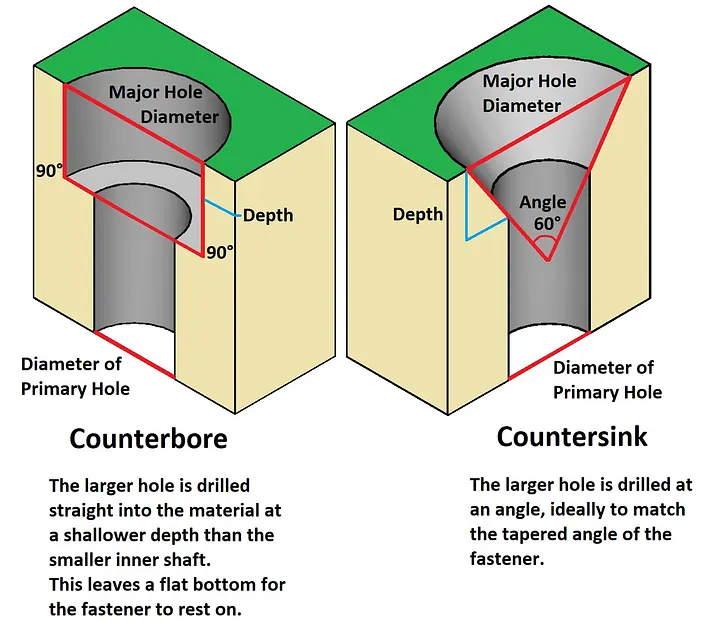
The Core Difference: Geometry and Function
The fundamental difference lies in the shape of the recess and the resulting fit with the fastener.
Countersink
A countersink is a conical hole cut into a material. Its primary purpose is to allow a flat-head screw (or a similar conical-headed fastener) to sit completely flush with — or even below — the material surface. This creates a smooth, aerodynamic, and safe finish with no protruding parts. You’ll commonly see countersinks used with flat-head screws.
Counterbore
A counterbore, in contrast, is a cylindrical flat-bottomed hole that accommodates the head of a socket-head cap screw (Allen bolt) or a bolt with a washer. The head sits within this cylindrical pocket, leaving a small, flat parallel gap above it. This gap is often filled with a set screw or a plastic plug for a finished look. Counterbores are designed for strength and alignment, not necessarily a perfectly flush surface.
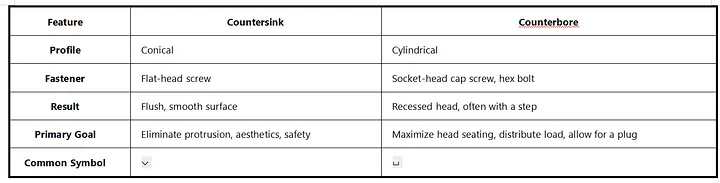
Visual and Functional Comparison
Key Applications: Where to Use Which?
Choose Countersink When:
Aerodynamics or Fluid Flow are critical (e.g., aircraft surfaces, fan blades).
Safety is paramount — you can’t have sharp edges or snag points.
Aesthetics require a perfectly smooth, uninterrupted surface.
Space is extremely limited in the vertical axis above the board or part.
Choose Counterbore When:
You need a stronger joint. Socket-head cap screws generally allow for higher torque and clamping force than flat-head screws.
The fastener head does not need to be perfectly flush, or you plan to use a plug.
You require precise vertical alignment of the fastener.
The material thickness allows for the deeper, straight-walled recess without compromising integrity.
Design and Manufacturing Considerations
Depth Control: This is crucial. An over-deep countersink leaves a gap around the screw head, weakening the hold. An over-deep counterbore wastes space and material. Precise machining or drilling is key.
PCB Applications: In PCB manufacturing, counterbores are more common for recessing standoff heads, while countersinks might be used for specific flush-mounting hardware. Both require careful planning in the stack-up to avoid damaging internal traces.
Callouts in Drawings: Always clearly specify the type (CSK or CBORE), the intended fastener size, and the desired major diameter and depth. Providing a detail view eliminates guesswork for the manufacturer.
Partnering for Precision
At SENTAK PCB, we understand that successful hardware integration is a cornerstone of durable and functional electronics. Our PCB fabrication and PCBA assembly services routinely handle complex mechanical requirements, including precise countersinking and counterboring for enclosures, heatsinks, and mounting points.
Our engineering team reviews your design files not just for electrical integrity, but for manufacturability (DFM) from a mechanical standpoint. We can advise on optimal hole sizing, material constraints, and the most reliable fastening strategy for your application — ensuring your boards are not only electrically sound but also mechanically robust and ready for seamless integration into the final product.
Conclusion
The choice between countersink and counterbore is a classic engineering trade-off between flush aesthetics and maximum fastening strength. By understanding their distinct geometries and purposes, designers can make informed decisions that enhance both the function and form of their products. Clear communication of these details in your design files is the final, essential step in turning a great design into a perfectly manufactured reality.